
The word “sustainable ” is everywhere. Sustainable fashion. Sustainable business. Sustainable tourism. Sustainable food systems. Yet when it comes to health and well-being, the term is still often misunderstood.
Most modern wellness trends are anything but sustainable. They promise rapid transformations, extreme detoxes, punishing exercise routines, restrictive diets, and biohacks that work for a season but collapse under the pressure of real life.
True sustainable health is something very different.
It is the ability to live well, physically, mentally, emotionally, and spiritually – without burning yourself out in the process.
And long before sustainability became a global buzzword, Ayurveda had already mapped the way.
What Does “Sustainable Health” Really Mean?
Sustainable health in 2026 is no longer about quick fixes. It is about systems.
A sustainable approach to wellbeing means:
• Habits that can be maintained for life
• Energy that remains steady rather than spiking and crashing
• Digestion that works without constant intervention
• Emotional resilience rather than emotional suppression
• Lifestyle practices that adapt with the seasons and stages of life
• A relationship with food and body that is rooted in wisdom, not fear
It is health that supports your work, your relationships, your creativity, and your purpose, without demanding that you sacrifice one part of yourself to maintain another.
This is exactly how Ayurveda has always defined well-being.
Ayurveda: The Original Model of Sustainable Living
Ayurveda, the 5,000-year-old science of life, never focused on “fixing” symptoms. It focused on creating balance.
It understood something modern culture is only now remembering:
Health is not built in gyms and clinics.
It is built in kitchens, bedrooms, daily routines, and quiet moments of self-awareness.
Ayurveda approaches sustainability through an integrated lens that includes:
• Individual constitution (dosha)
• Digestion and metabolism (agni)
• Toxic accumulation (ama)
• Daily and seasonal routines (dinacharya and ritucharya)
• Mental and emotional balance
• Purpose and alignment with nature
Rather than prescribing one universal diet or lifestyle, Ayurveda asks a radical question:
“What is sustainable for YOU?”
That single principle makes it more relevant today than ever.
Digestion: The Core of Sustainable Health
Modern wellness often focuses on what we eat.
Ayurveda focuses on how well we digest it.
From an Ayurvedic perspective, sustainable wellbeing begins with agni (the digestive fire). When agni is strong and balanced, food is transformed into nourishment, immunity, clarity, and vitality.
When agni is weak or erratic, even the healthiest diet becomes a burden.
This is why so many people in 2026 feel confused:
They eat “clean,” take supplements, follow protocol, yet still feel bloated, tired, anxious, or inflamed.
Ayurveda teaches that sustainable health is not about chasing superfoods.
It is about creating a digestive system that can actually use them.
Simple, timeless practices support this:
• Eating warm, freshly cooked meals
• Choosing foods appropriate to your constitution
• Eating at regular times
• Avoiding constant snacking
• Respecting hunger and fullness
• Using spices and herbs as daily medicine
These are not trends.
They are foundations.
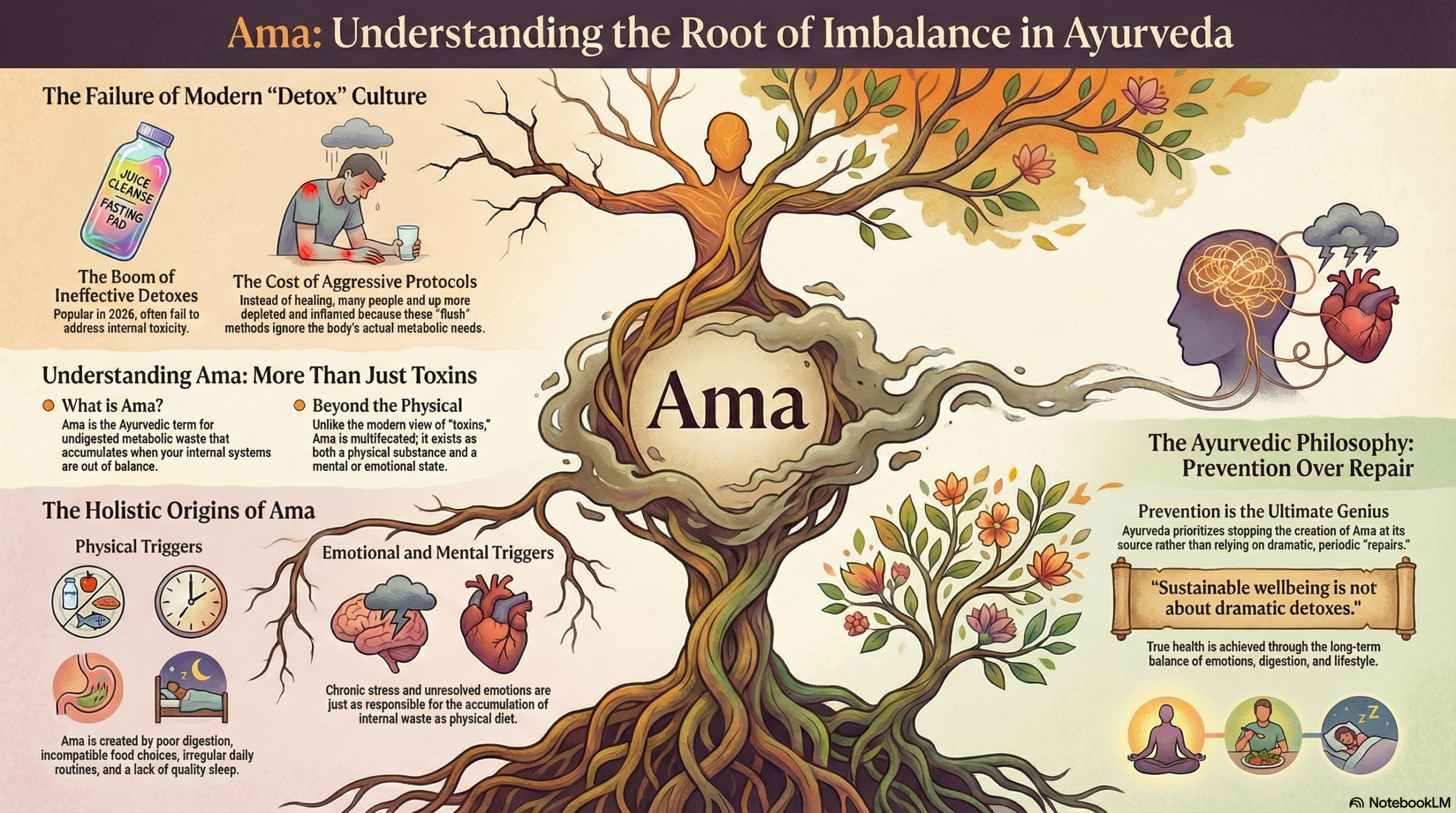
Ama: The Missing Conversation in Modern Wellness
In 2026, detox culture is booming, but it is rarely effective.
Juice cleanses, fasting fads, and aggressive protocols promise to “flush toxins,” yet many people end up more depleted and inflamed than before.
Ayurveda has always understood why.
The real issue is ama, undigested metabolic waste that accumulates when digestion, emotions, or lifestyle are out of balance.
Ama is not just physical. It is also mental and emotional.
Chronic stress, unresolved emotions, irregular routines, poor sleep, and incompatible foods all contribute to internal toxicity.
Sustainable wellbeing is not about dramatic detoxes.
It is about not creating ama in the first place.
That is the genius of Ayurveda: prevention over repair.
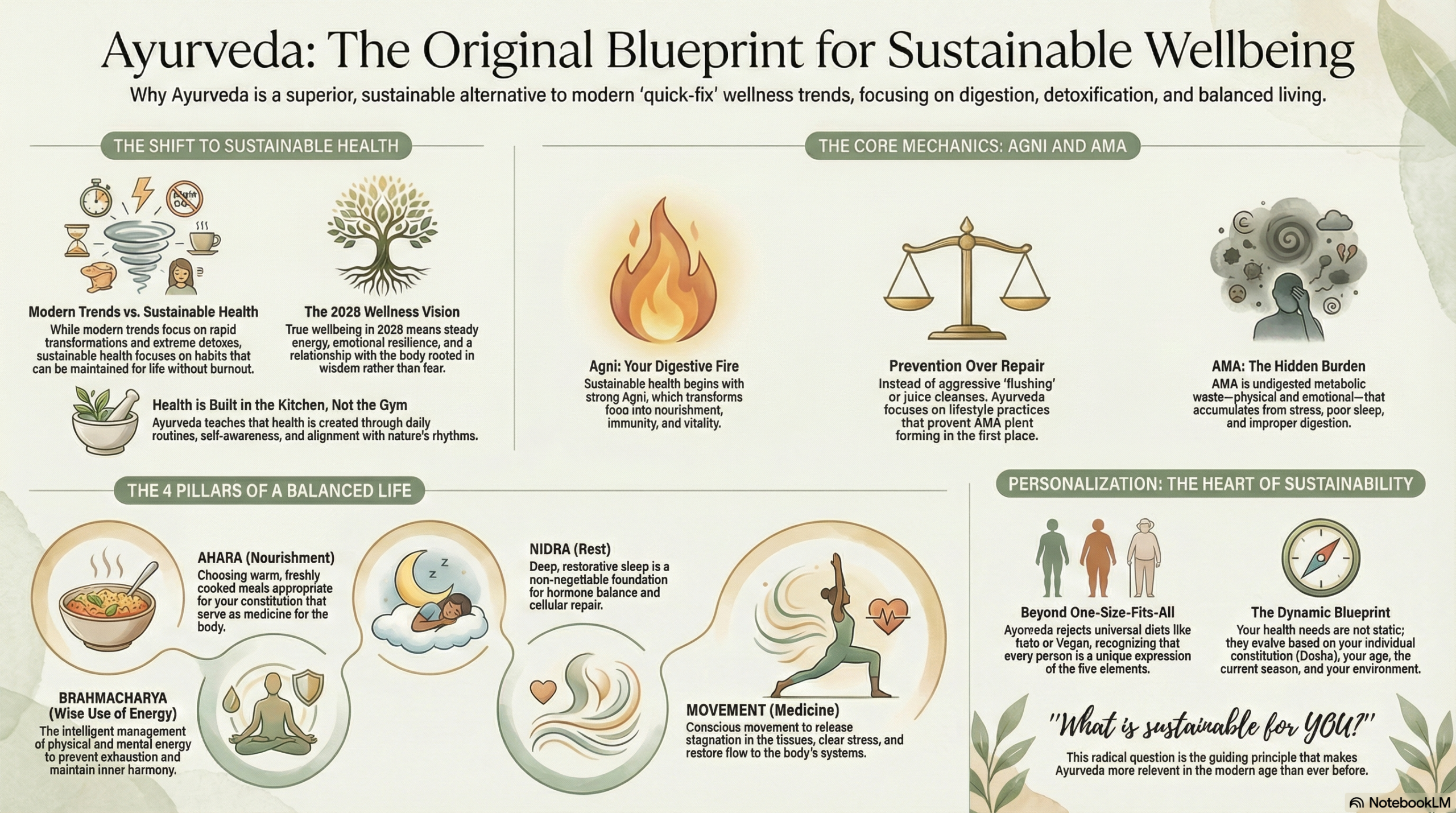
The Pillars of Life: Ayurveda’s Timeless Blueprint for Balance
Long before wellness culture turned “self-care” into a checklist, Ayurveda defined the true foundations of sustainable wellbeing through three essential pillars:
Ahara – Nourishment
Food is more than fuel. It is information for the body. When chosen wisely, prepared with intention, and eaten with presence, it becomes medicine that builds vitality, clarity, and resilience.
Nidra – Rest
Deep, restorative sleep is non-negotiable for lasting health. It governs immunity, hormones, emotional stability, and cellular repair. No supplement, smoothie, or wellness trend can replace the power of true rest.
Brahmacharya – Wise Use of Energy
Often misunderstood, this pillar is not about restriction—it is about balance. It calls for the intelligent management of physical, mental, and emotional energy so we live fully without depleting ourselves.
Together, these pillars create a way of life that supports longevity, strength, and inner harmony rather than exhaustion and burnout.
At the Ayurveda Alchemist Academy, we recognise that modern life asks more of the human body and nervous system than ever before. For this reason, we have expanded this model to include a fourth pillar: Movement.
Movement is medicine. The saying “the issues are in the tissues” reminds us that stress, emotions, and trauma are held in the body. Conscious movement allows fascia, lymph, blood, and muscle to release stagnation, create new neural pathways, and restore flow. Through breath, mobility, strength, and mindful physical practice, we give the body the chance to process, clear, and rebuild.
In 2026, when burnout, anxiety, and disconnection have become the norm, these pillars offer something profoundly radical—a practical, human, and sustainable way to live well for life.
Personalisation: The Heart of True Sustainability
One of the biggest reasons modern wellness fails is its obsession with universal solutions.
Keto. Vegan. Intermittent fasting. Cold plunges. HIIT training.
They work for some and harm others.
Ayurveda has never believed in one-size-fits-all.
It recognises that every person is a unique expression of the five elements. What is healing for one constitution may destabilise another.
Sustainable health is therefore deeply personal.
It evolves with:
• Your dosha
• Your age
• The season
• Your environment
• Your current state of balance
This adaptability is what makes Ayurveda endlessly practical rather than dogmatic.
Mental and Emotional Sustainability
Modern wellness often treats mental health as separate from physical health.
Ayurveda never made that mistake.
It is understood that digestion, emotions, nervous system health, and immunity are inseparable.
An anxious mind disturbs digestion.
Poor digestion disturbs the mind.
Sustainable wellbeing, therefore, includes:
• Daily grounding practices
• Breathwork and meditation
• Time in nature
• Emotional processing
• Rituals that calm the nervous system
These are not “extras.”
They are core medicine.
Sustainability Beyond the Individual
The Future of Wellbeing Is Ancient
As the world becomes faster, louder, and more complex, sustainable health will not be found in more technology, more restrictions, or more extremes.
It will be found in cellular wisdom.
Ayurveda remains the most complete model of sustainable wellbeing because it asks us to live intelligently, gently, and in rhythm with nature.
Not for a 30-day challenge.
Not for a summer body.
But for a lifetime.
Sustainable health in 2026 is not a trend.
It is a way of living.
And Ayurveda has been teaching it all along.
How I Apply Sustainable Health in My Own Practice
Sustainable wellbeing is not something I teach from theory. It is something I live.
In my own life, Ayurveda is not rigid or performative. It is rhythmic. I rise and rest with intention. I eat in a way that supports my digestion rather than challenges it. I adjust with the seasons. I keep room for fun and joy, not rigidity and rules. I pay attention to my nervous system. I respect my energy rather than overriding it.
There are seasons when I lean into deeper cleansing. There are seasons when nourishment and rebuilding are the medicine. Sustainability means I do not force my body into extremes. I listen.
This is the same philosophy I bring into client work.
What Sustainable Health Looks Like When I Work With Clients
When someone comes to me, I am not looking to “fix” them. I am looking to understand them.
We begin with the constitution.
We assess digestion.
We evaluate daily rhythm, sleep, emotional load, stress, and environment.
I ask:
Is your agni strong or depleted?
Is ama present?
Are your routines supporting you or draining you?
Are you living in alignment with your natural constitution—or fighting against it?
From there, we build sustainable systems.
Not extreme diets.
Not overwhelming protocols.
Not twenty supplements.
Instead, we focus on:
• Strengthening digestion first
• Simplifying meals
• Establishing regular eating times
• Restoring sleep
• Regulating the nervous system
• Introducing seasonal cleansing gently when appropriate
• Supporting the pillars of life before layering in anything advanced
If movement is required, it is intelligent and therapeutic, not punishing.
If detox is required, it is prepared for, not forced.
The body responds beautifully when it feels safe.
I also look at emotional digestion. Many clients carry unprocessed stress in the tissues. Through breathwork, mindful movement, and somatic practices, we create space for stored tension to release. This is where true transformation happens, not in the mind alone, but in the body.
The Difference My Clients Experience
When health becomes sustainable:
Energy stabilises.
Digestion becomes predictable.
Cravings reduce naturally.
Sleep deepens.
Emotional reactivity softens.
Confidence returns.
Most importantly, clients stop feeling like they are constantly “trying” to be healthy.
They are simply living in alignment.
That is sustainable wellbeing.
It is not dramatic.
It is not extreme.
It is consistent, intelligent, and embodied.
And that is what Ayurveda has always offered.
If this article resonated with you, it’s because you’re ready for a more sustainable way to live.
At the Ayurveda Alchemist Academy, we teach Ayurveda not as theory, but as a living system you can embody every day – personally and professionally.
Take the next step toward true sustainable wellbeing: Discover Our Training Pathways
Ready to go deeper?
Sustainable health is not built from trends – it’s built from knowledge, skills, and daily practice. If you’re ready to learn Ayurveda in a grounded, practical, and professional way, explore our flagship training:
Join the Ayurveda Alchemist Academy – Level 1 Ayurvedic Health Consultant Certification
Learn how to transform your own wellbeing and support others through the timeless wisdom of Ayurveda.
Want guidance on how to put these principles into action?
Explore our upcoming retreats, workshops and events
From Ayurvedic nutrition and digestion to nervous system regulation and daily rituals, our programs are designed to make sustainable health simple and achievable. View Upcoming Retreats, Workshops & Gatherings