
Why Your Biology Is Not Your Destiny
By Jasmine Grace
There is a profound shift occurring in health and wellness.
For decades, we were taught that our genes determined our future. That our family history dictated our risk of disease. That our biology was fixed.
Yet modern science is revealing something extraordinary.
Your genes are not your destiny.
The emerging field of epigenetics—the study of how lifestyle and environment influence gene expression—is transforming our understanding of health, ageing, resilience, and disease.
For those of us who have spent decades studying Ayurveda, this revelation feels deeply familiar.
Because Ayurveda has always understood that while we inherit a unique constitution, it is the way we live that determines whether health or disease unfolds.
More than 5,000 years ago, Ayurvedic sages understood something that science is only now beginning to confirm:
The body is constantly responding to its environment.
Every meal.
Every breath.
Every thought.
Every relationship.
Every experience.
All are influencing the expression of health.
What Is Epigenetics?
The word epigenetics literally means “above the genes.”
While our DNA provides the blueprint, epigenetics determines how that blueprint is read and expressed.
Imagine two people inheriting the same genetic predisposition.
One develops chronic disease.
The other remains healthy and vibrant throughout life.
Why?
Because genes create possibilities.
Environment creates outcomes.
Factors that influence gene expression include:
Nutrition
Sleep quality
Stress levels
Physical activity
Emotional wellbeing
Social connection
Exposure to toxins
Mindfulness and meditation practices
The emerging science is clear.
Lifestyle matters.
Perhaps more than we ever imagined.

Ayurveda’s Ancient Understanding of Genetic Potential
In Ayurveda, this principle is reflected through the concepts of Prakruti and Vikruti.
Prakruti
Your constitutional blueprint.
The unique combination of Vata, Pitta and Kapha established at conception.
Your innate tendencies.
Your strengths.
Your vulnerabilities.
Vikruti
Your current state.
How life experiences, stress, habits, relationships, environment and aging have influenced your system.
Ayurveda has never sought to change your Prakruti.
Instead, it teaches us how to create conditions that allow our constitution to express its highest potential.
In modern language:
Ayurveda teaches epigenetic optimisation.
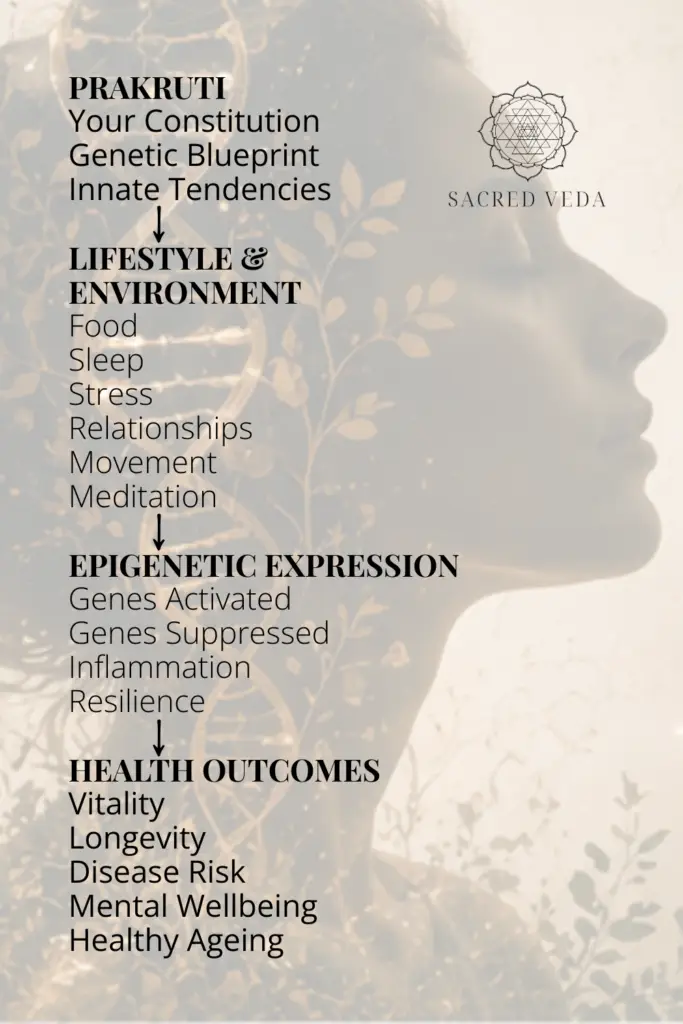
Diagram: Prakruti and Vikruti
Prakruti (Blueprint)
↓
Lifestyle & Environment
↓
Daily Choices
↓
Gene Expression
↓
Vikruti (Current Expression)
↓
Health or Disease
The Missing Conversation: The Nervous System
One of the most fascinating discoveries in modern medicine is the role of chronic stress in gene expression.
When the nervous system remains in prolonged states of survival:
Inflammation increases
Immune function decreases
Hormonal balance shifts
Digestive function weakens
Cellular repair slows
Ayurveda has described this process differently.
It teaches that excessive stress disturbs:
Prana
The intelligence governing the nervous system.
Agni
The digestive and transformational fire.
Ojas
The body’s deepest reserve of vitality and resilience.
When Prana becomes disturbed, Agni weakens.
When Agni weakens, Ama accumulates.
When Ama accumulates, Ojas declines.
This creates the foundation for dysfunction throughout the body.
Remarkably, modern research into inflammation, stress physiology and epigenetics mirrors this ancient understanding.
Diagram: Stress Pathway
Chronic Stress
↓
Nervous System Dysregulation
↓
Impaired Digestion & Recovery
↓
Inflammation
↓
Altered Gene Expression
↓
Disease Risk
Ayurvedic Translation
Prana Disturbance
↓
Agni Weakness
↓
Ama Accumulation
↓
Ojas Depletion
↓
Disease Expression
Meditation, Breathwork & Epigenetic Health
Perhaps nowhere is the convergence between modern science and Ayurveda more exciting than in the study of meditation.
Research suggests meditation may influence:
Stress response pathways
Inflammatory markers
Telomere health
Gene expression related to longevity
Emotional regulation
Immune resilience
For thousands of years, Ayurvedic and yogic traditions have taught that meditation is not simply relaxation.
Meditation is a biological intervention.
A nervous system intervention.
A consciousness intervention.
When we regulate the breath, calm the mind and cultivate awareness, we create internal conditions that support healing and resilience.
This is one of the reasons meditation remains a cornerstone of every authentic Ayurvedic lifestyle.
The Future Is Personalised
The future of healthcare is not one-size-fits-all.
It is personalised.
Individualised.
Constitutional.
Exactly as Ayurveda has always taught.
The question is no longer:
“What disease do you have?”
The question is:
“Who are you?”
How do you digest?
How do you sleep?
How do you respond to stress?
What nourishes your body?
What depletes your vitality?
What creates balance for your unique constitution?
These are the questions that lead us toward true health.
A Return to Ancient Wisdom
As science advances, many of the world’s oldest healing traditions are being revisited with fresh eyes.
Ayurveda is not becoming relevant because science validates it.
Ayurveda has always been relevant.
Science is simply beginning to catch up.
The future of wellness lies not in choosing between ancient wisdom and modern science.
It lies in integrating both.
When we combine the timeless principles of Ayurveda with the emerging understanding of epigenetics, we gain a powerful framework for health, resilience, longevity and human flourishing.
Your genes are not your destiny.
Your daily choices matter.
And every day offers an opportunity to write a different story.
About Jasmine Grace
Jasmine Grace is a Clinical Ayurvedic Practitioner, Panchakarma Specialist, meditation and breathwork educator, and Co-Founder of the Ayurveda Alchemist Academy. For more than two decades she has worked at the intersection of Ayurveda, nervous system regulation, meditation, breathwork, lifestyle medicine and holistic wellbeing, helping individuals reconnect with their innate capacity for healing, resilience and transformation.
If this article resonated with you, it’s because you’re ready for a more sustainable way to live.
At the Ayurveda Alchemist Academy, we teach Ayurveda not as theory, but as a living system you can embody every day – personally and professionally.
Take the next step toward true sustainable wellbeing: Discover Our Training Pathways
Ready to go deeper?
Sustainable health is not built from trends – it’s built from knowledge, skills, and daily practice. If you’re ready to learn Ayurveda in a grounded, practical, and professional way, explore our flagship training:
Join the Ayurveda Alchemist Academy – Level 1 Ayurvedic Health Consultant Certification
Learn how to transform your own wellbeing and support others through the timeless wisdom of Ayurveda.
Want guidance on how to put these principles into action?
Explore our upcoming retreats, workshops and events
From Ayurvedic nutrition and digestion to nervous system regulation and daily rituals, our programs are designed to make sustainable health simple and achievable. View Upcoming Retreats, Workshops & Gatherings